














Description
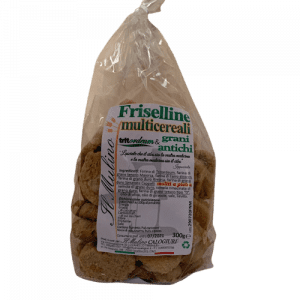
Homemade-style biscuits made with Tritordeum flour.
Il Mulino Calogiuri, an artisan mill in Salento since 1960, bakes these biscotti with flour from Tritordeum, a cereal born from the natural cross of durum wheat and wild barley. The recipe is short: Tritordeum flour, sugar, milk, eggs, olive oil, water, ammonium bicarbonate and salt. The producer describes a crisp outside and a soft centre; per 100 g they carry 12 g of fibre and 14 g of protein.
Tritordeum was bred in Córdoba, Spain, at a public agricultural research institute, through a natural cross of durum wheat and Hordeum chilense, a wild barley from Chile and Argentina; the work began in the late 1970s and the grain reached the market in 2013. Its flour has a golden colour that comes from lutein, a carotenoid it carries at higher levels than common wheat.
For restaurants and chefs. Serve them at breakfast or with coffee at the end of a meal. Crumbled, they make a base for cheesecake, a layer in a semifreddo or a crunchy topping for panna cotta. With 2.73 g of sugars per 100 g, they sit well next to sweet creams and fruit compotes.
For specialty and Italian stores. Tritordeum is still a new name for most shoppers, which gives staff a story to tell: a recent cereal, milled and baked by a third-generation family mill in Salento. The 350 g bag suits breakfast shoppers and works as a small gift next to coffee or tea. Sold together with the pasterelle and quaresimali from the same mill, it builds a compact Salento biscuit range.
Specs: 350 g, case of 10, shelf life 6 months, Puglia (Italy).
Ingredients: Tritordeum flour, sugar, milk, eggs, olive oil, water, ammonium bicarbonate, salt.
Nutrition per 100 g: 320 kcal, fat 2.2 g (saturated 0.5 g), carbohydrates 60 g (sugars 2.73 g), fibre 12 g, protein 14 g, salt 0.003 g.
Allergens: gluten, milk, eggs.